
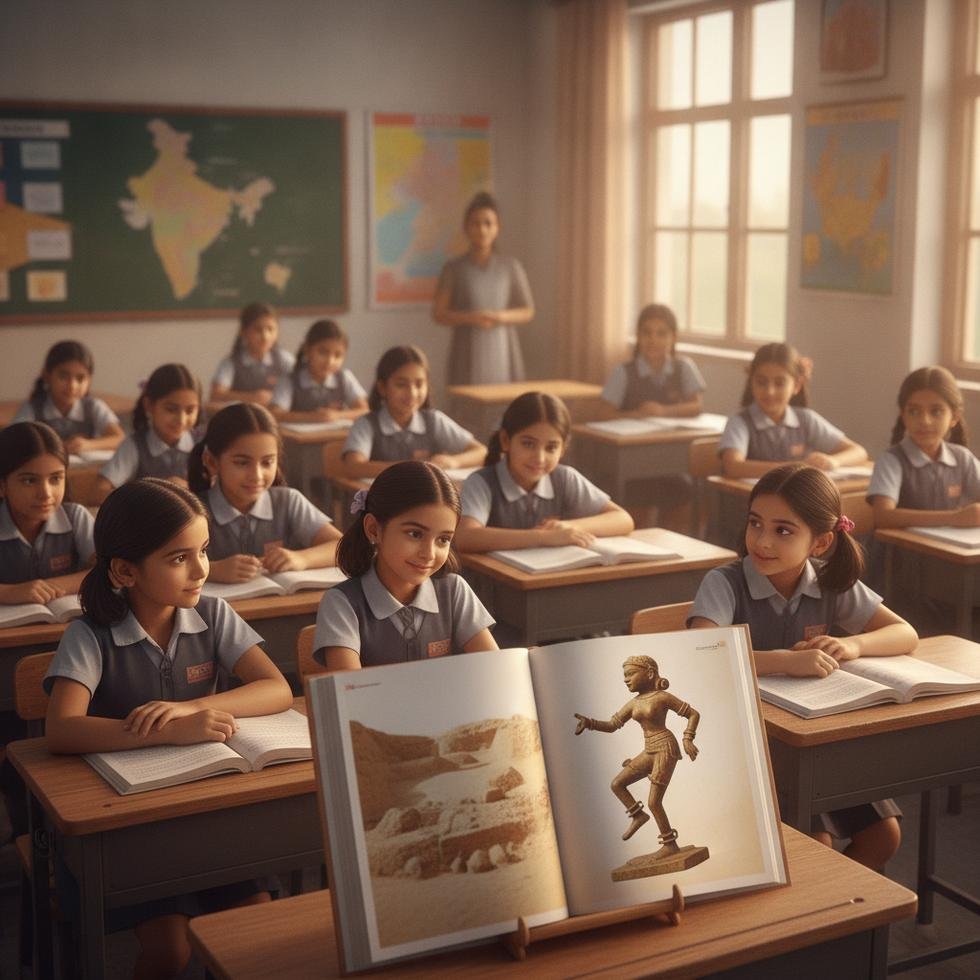
In India, a controversy surrounding the depiction of the famous ‘Dancing Girl’ figurine in school textbooks has led to a reversal after public outcry. The new textbook initially altered the ancient sculpture’s image by covering her bare torso with dark shading, which sparked criticism from historians and educators. They argued that the modification not only distorted an important piece of cultural heritage but also did not align with historical accuracy.
The ‘Dancing Girl’ is a bronze artifact roughly 4500 years old, discovered in the famous archaeological site of Mohenjo-Daro in Pakistan. It is celebrated for its depiction of artistic and cultural aspects of the Indus Valley Civilization. The decision to restore the original depiction came after academics emphasized the educational necessity of presenting unaltered historical artifacts to students.
The educational system in India has long sought to balance cultural sensitivity with historical integrity, often leading to debates over curriculum content. Experts stated that the textbook committee’s decision to initially change the image was an overcorrection in response to pressure for more culturally sensitive portrayals in educational materials.
Restoring the original depiction is seen as a significant victory for those advocating for the importance of historical accuracy in educational contexts. This incident highlights the ongoing conversation in educational circles about the interpretation and display of historical artifacts.
Source: [BBC News](https://www.bbc.com/news/articles/c7vyzgl2142o?at_medium=RSS&at_campaign=rss)